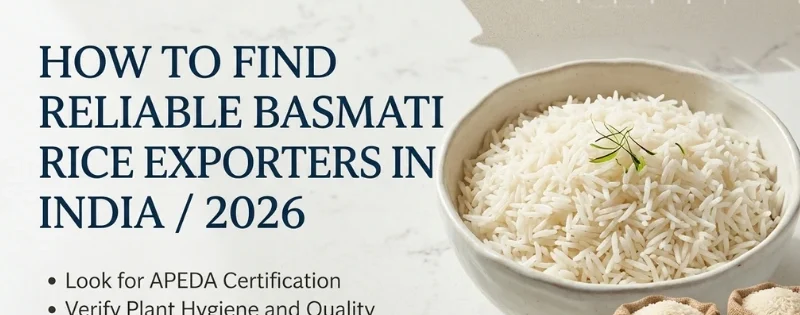
Placing a six-figure rice order with someone you found through a single email exchange is how a lot of bulk buyers learn the hard way that not every exporter listed online is who they claim to be. India ships basmati to well over a hundred countries every year, and that scale brings genuine industry leaders alongside intermediaries who add risk without adding value.
This guide walks through exactly how to separate the two, what documentation actually matters, and why something like Indian Sella basmati rice has its own specific verification points that buyers often miss.
None of this requires specialised trade expertise. Most of the verification process described here is something any procurement manager can do in an afternoon, using publicly available government portals and a handful of direct questions that a genuine exporter will answer without hesitation.
Why Verification Matters More Than a Good Sales Pitch
A polished website and a quick response time say very little about whether an exporter can actually deliver a 20-foot container on schedule, at the agreed specification, without a quality dispute at the destination port. Basmati rice exporters from India operate at wildly different scales, and the gap between a genuine mill-backed exporter and a trading intermediary only becomes obvious once something goes wrong mid-shipment.
The good news is that the Indian government has built a fairly transparent verification system around agricultural exports, and most of it is publicly checkable before any money changes hands.
This matters even more when the order involves a specific product variant rather than generic basmati. Buyers sourcing parboiled grades or container-scale volumes are exposed to a different level of risk than someone ordering a single retail pallet, simply because more can go wrong across a longer supply chain and a larger sum of money.
The Documents Every Genuine Exporter Should Hold
APEDA Registration
Every legitimate exporter of basmati rice from India needs an e-Registration Cum Membership Certificate, commonly called RCMC, issued through APEDA, the government body overseeing agricultural export quality and standards. This registration confirms the exporter has gone through a formal vetting process tied to food safety and traceability requirements, not just a business registration.
Asking for the RCAC (Registration-cum-Allocation Certificate) tied to basmati rice specifically is a reasonable next step, since this confirms the exporter has cleared the additional checks specific to basmati as a geographically protected product category.
Importer Exporter Code
An IEC issued by the Directorate General of Foreign Trade is the baseline requirement for anyone exporting from India, basmati or otherwise. It’s worth cross-checking this code independently on the DGFT portal rather than simply taking a screenshot at face value, since this number is tied directly to the legal entity behind the shipment.
ISO and Food Safety Certifications
ISO 9001 or ISO 22000 certification signals that an exporter has documented quality management processes in place, not just good intentions. For shipments headed to Saudi Arabia specifically, rice establishments are required to meet international food safety standards such as ISO 22000 or HACCP, so this isn’t an optional nice-to-have for that corridor; it’s a requirement.
FSSAI registration is the domestic counterpart worth checking alongside these international certifications, since it confirms the exporter’s processing facility is registered under India’s own food safety law rather than operating purely as a paperwork-only trading entity with no real processing footprint.
What to Check Beyond the Paperwork
Track Record and Shipment History
Certificates establish that an exporter is legally allowed to ship rice. They say very little about whether that exporter consistently delivers what was promised. Asking for verifiable shipping records, even anonymised, along with references from existing buyers gives a much clearer picture of reliability than certification alone.
Exporters of basmati rice from India who have nothing to show in terms of repeat business or shipment history aren’t automatically untrustworthy, but the absence of a track record shifts more risk onto the buyer, and pricing or payment terms should reflect that.
Third-Party Inspection Before Shipment
Independent, pre-shipment inspection is standard practice in commodity trade for good reason. A third-party agency checking moisture content, grain length, and overall quality against the agreed specification before the container is sealed protects the buyer from disputes that are far harder to resolve once goods have already left port.
Any exporter who resists this kind of inspection, or treats the request as an insult rather than a normal part of doing business, is worth treating cautiously.
Facility and Capacity Reality Check
A genuine exporter, particularly one offering large or recurring volumes, should be able to speak specifically about milling capacity, storage conditions, and where the paddy is actually sourced from. Vague answers about “multiple sourcing locations” without specifics are common from intermediaries reselling capacity they don’t directly control.
It’s reasonable to ask which Indian state the paddy is grown in, since basmati cultivation is concentrated in specific belts across Punjab, Haryana, and parts of Uttar Pradesh and Madhya Pradesh, and an exporter who can’t name their sourcing region with any confidence is likely several steps removed from the actual mill.
Why Indian Sella Basmati Rice Has Its Own Verification Layer
What Makes Sella Different
Sella basmati goes through a parboiling process before milling, which locks starch inside the grain and produces a noticeably stronger kernel that resists breaking during prolonged cooking. This matters enormously for buyers serving large-volume kitchens, since dishes that rely on rice holding its shape through extended cooking times, like kabsa or mandi, depend on exactly this characteristic.
Why Saudi and Gulf Buyers Specifically Trust It
Demand for Indian Sella basmati rice has grown substantially across Saudi Arabia and the wider Gulf region, largely because it performs reliably at the scale restaurants, hotels, and large catering operations require. That trust has built up over years of consistent quality and on-time delivery rather than through marketing, which means a new exporter claiming to match that reputation overnight deserves a closer look.
Specification Points Unique to Sella
When verifying a Sella-specific order, ask about the parboiling method used, average grain length after processing, and aging duration, since Sella rice aged for a year or more typically commands a quality premium tied to improved texture and aroma. A vague specification sheet that doesn’t separate Sella from raw or steamed basmati is a sign the exporter may not be handling Sella as its own distinct product line.
Packaging also deserves a closer look for Sella shipments bound for humid climates. Moisture-barrier packaging matters more for parboiled rice traveling long distances by sea, since any moisture ingress during transit can affect both shelf life and cooking performance at the destination, undoing the very durability that makes Sella valuable in the first place.
Red Flags Worth Taking Seriously
An exporter unwilling to share their APEDA RCMC number, reluctant to allow third-party inspection, or offering pricing dramatically below the prevailing market rate without a clear explanation are all signals to slow down rather than speed up a deal. Genuine exporters of basmati rice from India operate within fairly transparent margins, and prices that look too good usually involve a quality compromise that surfaces only after the rice has already shipped.
Equally, an exporter who can’t answer basic questions about container loading capacity, typical transit times to your specific port, or standard payment terms like letters of credit is likely newer to export than their marketing suggests.
Moving From Verification to a First Order
None of this verification process needs to feel adversarial. A reliable exporter expects these questions and usually has documentation ready before being asked. Once APEDA registration, IEC, and relevant food safety certifications check out, requesting a smaller trial shipment before committing to a full container load is a sensible way to confirm consistency in person rather than on paper.
That trial order, paired with an independent pre-shipment inspection, tells far more about an exporter’s reliability than any website or sales call ever will.
Treat the first order as the real test, not the sales conversation that preceded it. Exporters who perform well on a smaller trial, who communicate clearly through any minor hiccups, and who provide documentation without being chased are the ones worth building a long-term sourcing relationship with as volumes grow.