If there is one rice variety that has quietly reshaped the global basmati trade over the past two decades, it is 1121 Sella Basmati Rice. Walk into any wholesale grain market in Dubai, browse the shelves of a South Asian grocery store in London, or visit a high-capacity rice mill in Haryana and you will find 1121 at the center of every major conversation about basmati.
Yet for all its commercial dominance, many buyers, importers, and food business owners still have fundamental questions about this variety. What exactly is 1121 Sella Basmati Rice? What is the difference between Golden Sella, White Sella, and Steam? What quality parameters should you check before placing a bulk order? And how do you find a reliable exporter in India?
This guide answers every one of those questions in full. Whether you are a first-time importer sourcing basmati rice for a supermarket chain, a restaurant owner looking for the best rice for your biryani menu, or a distributor evaluating Indian rice exporters this is the most complete resource you will find on 1121 Sella Basmati Rice.
What Is 1121 Basmati Rice? Origin and Background
The story of 1121 Basmati Rice begins in the research laboratories of the Indian Agricultural Research Institute (IARI) in Karnal, Haryana. Scientists there spent years developing a basmati variety that would combine the traditional aromatic qualities of classic basmati with superior agronomic performance higher yield, greater disease resistance, and exceptional grain elongation after cooking.
The result, released for commercial cultivation in 2003, was Pusa Basmati 1121. The number “1121” refers to the variety’s research identification code. Within a few years of its commercial release, this rice had overtaken traditional basmati varieties in terms of export volume and become the single most traded basmati rice in the world.
What makes 1121 so special? Three things primarily:
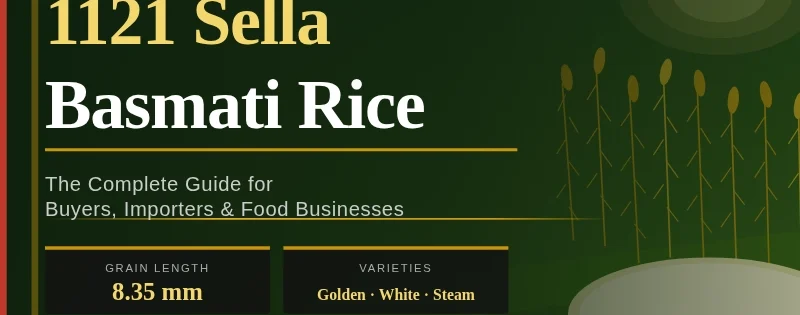
Grain Length. 1121 Basmati Rice has an average raw grain length of 8.35 mm among the longest of any commercially cultivated rice variety in the world. After cooking, the grain elongates to approximately 20-22 mm, more than doubling in length while remaining separate, firm, and non-sticky.
Aroma. Like all true basmati, 1121 contains high concentrations of 2-acetyl-1-pyrroline (2-AP), the chemical compound responsible for the characteristic popcorn-like fragrance that makes basmati rice prized across the Middle East, Europe, and South Asia.
Yield and Availability. Because 1121 gives farmers significantly higher yields per acre compared to traditional basmati varieties, India can produce it in sufficient volume to supply global demand at competitive prices.
Today, 1121 Basmati Rice accounts for a substantial portion of India’s total basmati rice exports, which in recent years have exceeded 4.5 million metric tons annually, generating billions of dollars in foreign exchange. Countries from Saudi Arabia and the UAE to the United Kingdom, Germany, and the United States are among the world’s largest importers of Indian 1121 Basmati.
Understanding “Sella” What Does It Mean?
Before going any further, it is important to understand what “Sella” means because it is a term that confuses many new buyers.
Sella refers to the parboiling process. When freshly harvested rice paddy is treated with steam and then dried before milling, the result is called Sella or parboiled rice. This process causes the starch within the grain to gelatinize partially, making the rice firmer, more nutritious, and significantly more resistant to breakage during milling and cooking.
Parboiling has been practiced in South Asia for centuries, particularly in areas where rice is a dietary staple and grain breakage during milling is a concern. In the context of export-grade 1121 Basmati, the Sella process has an additional benefit: it locks in the grain’s natural color, aroma compounds, and nutritional content far more effectively than raw processing.
It is worth noting here that not all 1121 Basmati is Sella. 1121 Basmati also comes in a raw or white form simply milled without parboiling. Understanding the difference between these processing types is fundamental to buying the right product for your specific application.
The Three Main Types of 1121 Sella Basmati Rice Explained in Full
This is where most buyers get confused. When an Indian exporter offers you “1121 Sella Basmati Rice,” they are usually referring to one of three specific processing types. Each has distinct visual characteristics, flavor profiles, cooking properties, and ideal end uses. Here is a complete breakdown:
1121 Golden Sella Basmati Rice
Golden Sella is the most visually distinctive variety. During the parboiling process, the rice takes on a warm golden or amber color this happens because the natural pigments from the outer bran layer migrate into the grain during steaming. The result is a pale gold to deep yellow rice that, when cooked, turns a beautiful white and elongates dramatically.
Golden Sella is highly popular in the Middle East particularly in Saudi Arabia, the UAE, Iraq, and Kuwait where it is the preferred rice for Kabsa, Mandi, and large-format catering. The golden color is actually a sign of proper processing and is associated with premium quality in these markets. Buyers who are unfamiliar with Golden Sella sometimes mistake the color for impurity or age but this is incorrect. The color is entirely natural and disappears upon cooking.
Key Characteristics:
Raw color: Golden/amber
Cooked color: Bright white
Grain elongation: 20-22mm after cooking
Texture after cooking: Firm, separate, non-sticky
Moisture: 13% max
Broken percentage: 2% max
Best for: Kabsa, Mandi, large-scale catering, hotels, food service
1121 White Sella Basmati Rice
White Sella undergoes the same parboiling process as Golden Sella but for a shorter duration or at a lower intensity, resulting in a much lighter, cream-white color rather than gold. This makes White Sella visually closer to raw/white basmati while still retaining most of the benefits of parboiling particularly the reduced breakage and improved shelf life.
White Sella is preferred in markets where consumers are accustomed to white rice and may find the golden color of Golden Sella unusual. It is widely exported to European markets, the United Kingdom, the United States, and parts of Africa.
Key Characteristics:
Raw color: Cream-white
Cooked color: Bright white
Grain elongation: 20-22mm after cooking
Texture after cooking: Slightly softer than Golden Sella but still separate
Moisture: 13% max
Broken percentage: 2% max
Best for: Retail markets in UK, EU, USA; biryani, pulao, pilaf; restaurant use
1121 Steam Basmati Rice
Steam Basmati is also parboiled, but the process involves full steam treatment followed by aggressive drying before milling. The result is a rice with a completely white appearance, maximally firm grain structure, and the lowest broken rice percentage of the three types.
Steam Basmati is the most industrial of the three it is widely used in large-scale food processing, restaurant chains, and any application where the rice will be cooked in bulk and needs to hold its shape perfectly even when slightly overcooked or held warm for extended periods. Hotels, airline catering, hospital kitchens, and large restaurant chains across the Middle East, Europe, and South Asia rely on Steam Basmati precisely for this reason.
Key Characteristics:
Raw color: Bright white
Cooked color: Brilliant white
Grain elongation: 20mm+ after cooking
Texture after cooking: Very firm, completely separate grains, highest non-sticky quality
Moisture: 13% max
Broken percentage: 1.5-2% max
Best for: Commercial kitchens, airline catering, food processing, bulk institutional use
1121 Basmati Rice Quality Parameters What Serious Buyers Check
Whether you are importing 25 metric tons or 500 metric tons of 1121 Sella Basmati Rice, quality parameters are the language of every professional transaction. Here are the key specifications you should always confirm with your supplier before placing an order:
Average Grain Length (Raw): Should be minimum 8.3mm for genuine 1121 variety. Any exporter offering 1121 with a raw grain length below 8.0mm is either supplying a blend or a lower-grade variety.
Moisture Content: Maximum 13%. Above this, the rice is at risk for mold growth during long shipping periods. Always ask for a moisture certificate from the processing facility.
Broken Rice Percentage: For export-grade 1121 Sella, broken content should not exceed 2%. Higher broken percentages reduce cooking quality significantly and indicate either poor milling or excessive moisture damage.
Damage and Discolored Kernels: Maximum 1%. Damaged kernels affect the visual appearance and taste of the cooked rice and are a sign of poor paddy sourcing or inadequate quality control during milling.
Admixture: Maximum 1%. Admixture refers to foreign material stones, husk fragments, seeds from other plants in the rice. Any reputable exporter using Sortex optical sorting machines should have no difficulty meeting this standard.
Cleaning Standard: Always specify Sortex Cleaned (electronically sorted using color-sorting machines). This is the industry standard for export-grade basmati rice and eliminates discolored grains, damaged kernels, and foreign matter that hand-cleaning cannot remove.
Certifications: For serious bulk imports, always verify that the exporter holds APEDA (Agricultural and Processed Food Products Export Development Authority) registration, which is mandatory for all basmati rice exports from India. Additional certifications to look for include ISO 22000 (Food Safety Management), HACCP, and FSSAI compliance.
1121 Basmati Rice Export Price Understanding the Market
Pricing is always the first question an importer asks, and rightly so. 1121 Sella Basmati Rice prices fluctuate based on paddy procurement costs, seasonal harvest quality, global demand, and currency exchange rates. However, here are indicative price ranges that give you a benchmark for 2026:
Prices are indicative FOB (Free on Board) rates from Indian ports including Mundra, Nhava Sheva, and Kandla. Actual prices depend on order volume, packaging specification, and supplier margin. Always request a formal quote.
A few important pricing concepts every importer should understand:
FOB (Free on Board): The exporter’s price includes delivery to the port and loading onto your vessel. You arrange and pay for ocean freight, insurance, and destination customs.
CIF (Cost, Insurance, Freight): The exporter’s price includes the cost of the rice, ocean freight to your destination port, and marine insurance. This is a more complete price for buyers who prefer not to manage freight independently.
CNF (Cost and Freight): Similar to CIF but without insurance the exporter covers cost and freight to destination port, but the buyer arranges insurance.
For new importers, CIF is often the simpler option until you have established freight relationships.
How 1121 Sella Basmati Rice is Packaged for Export
Packaging specification is an important but often overlooked part of the buying process. 1121 Sella Basmati Rice for export is typically available in the following packaging options:
25 KG PP (Polypropylene) Bags: The most common packaging for international trade. Sturdy, moisture-resistant, and easy to handle in warehouses and container loading. A standard 20-foot container holds approximately 25-26 metric tons in 25kg bags (1,000-1,040 bags per container).
50 KG PP Bags: Used for wholesale bulk buyers, particularly in Africa and the Middle East where 50kg sacks are standard retail and wholesale units.
Custom Branded Bags: Most Indian exporters, including established suppliers in Gujarat and Haryana, offer private label packaging. You can supply your own brand design, and the exporter will pack and seal the bags with your label. This is widely used by supermarket chains, distributors, and rice brands across Europe, the UK, and the USA.
BOPP (Biaxially Oriented Polypropylene) Bags: Higher-quality printed bags used for premium retail presentation. More expensive than plain PP but gives a much better shelf appearance for consumer-facing packaging.
Top Export Destinations for 1121 Sella Basmati Rice from India
Understanding where 1121 Basmati Rice is most in demand globally helps importers and distributors benchmark their market positioning:
Saudi Arabia is historically the single largest importer of Indian basmati rice, with 1121 Golden Sella being the dominant variety. Kabsa the national dish is made with long-grain aromatic rice, and Indian 1121 is the standard ingredient in both home cooking and large-scale restaurant preparation.
The UAE and wider Gulf region collectively import millions of metric tons of Indian basmati annually. Dubai’s role as a re-export hub means that Indian 1121 Sella distributed through UAE reaches markets across East Africa, the broader Middle East, and Central Asia.
United Kingdom is Europe’s largest individual market for basmati rice. The large South Asian diaspora community drives consistent retail demand, and 1121 White Sella and Steam are the dominant varieties in UK supermarkets and cash-and-carry wholesale channels.
The United States has a rapidly growing basmati rice market driven by both the Indian-American community and mainstream consumer interest in healthier, aromatic rice varieties. US FDA compliance, including pesticide residue standards and proper labelling, is mandatory for all rice entering the American market.
African markets particularly East Africa (Kenya, Tanzania, Uganda) and West Africa (Nigeria, Ghana) are among the fastest-growing destinations for Indian 1121 Sella. Price competitiveness and the rice’s ability to be cooked in a variety of traditional methods make it especially popular.
How to Find and Evaluate a Reliable 1121 Basmati Rice Exporter in India
This is arguably the most important section for any new importer. The Indian rice export industry is large and diverse, with genuine long-established exporters operating alongside short-term traders. Here is how to evaluate potential suppliers:
Step 1 Verify APEDA Registration
All legitimate basmati rice exporters in India must be registered with APEDA. Ask for the APEDA registration number and verify it on the APEDA official portal. This is the single most important compliance check any exporter who cannot provide an APEDA number should be avoided.
Request a Physical Sample
Before placing any order, always request a physical sample of the specific variety, processing type, and packaging you intend to order. A genuine exporter will send samples promptly. Evaluate grain length, color uniformity, aroma, moisture, and the absence of broken or discolored grains.
Ask for Third-Party Quality Certificates
Reputable exporters have their rice tested by accredited third-party laboratories. Ask for recent lab reports showing moisture content, broken percentage, pesticide residue results, and grain dimension measurements.
Check for Trade References
Ask for references from existing import customers in your target market. A supplier who has exported to buyers in your country before will understand local regulatory requirements, preferred packaging, and delivery timelines.
Start with a Trial Order
Never commit your full annual volume to a new supplier on the first order. Start with a single container (25-26 MT) as a trial order. This lets you verify actual quality against the promised specification before committing to a larger commercial relationship.
Clarify Payment Terms Early
Standard payment terms in the Indian rice export trade include Letter of Credit (LC) at sight, 30% advance with balance against documents, and bank transfer (TT). Establish payment terms clearly in writing before any order is confirmed.
1121 Sella Basmati Rice for Food Businesses Hotels, Restaurants and Catering
For food business operators hotel chains, restaurant groups, catering companies 1121 Sella Basmati Rice offers a combination of quality consistency and economic viability that few other rice varieties can match.
For Biryani: 1121 Golden Sella or White Sella is the professional chef’s first choice. The grain elongates beautifully during the dum cooking process, absorbs spices evenly, and holds its structure even when cooked in large batches. The result is consistently long, separate, aromatic grains exactly what every biryani demands.
For Bulk Rice Service: 1121 Steam Basmati is ideal for hotel buffets, airline meals, and institutional catering where rice is cooked hours in advance and held warm before service. Steam-processed grains hold their texture and separation even when sitting in a bain-marie for extended periods.
For Rice Bowls and Modern Cuisine: 1121 White Sella is increasingly popular in restaurants serving fusion, Middle Eastern, or modern South Asian cuisine. Its clean white appearance, long grain, and mild aroma complement a wide range of preparations beyond traditional biryani.
Purchasing Advice for Food Businesses: Buy directly from an APEDA-registered Indian exporter or through a verified importer-distributor in your country. Consistent quality from a single source is more valuable than marginally lower prices from multiple inconsistent suppliers. Establish a standard specification document with your supplier stating grain length, moisture, broken percentage, and cleaning standard and hold them to it on every shipment.
Common Mistakes Buyers Make When Purchasing 1121 Sella Basmati Rice
Experience in the trade reveals that certain buying mistakes are remarkably common, especially among first-time importers and food businesses making their first bulk purchase:
Confusing variety names. “1121 Sella” is not a single product it is a category that includes Golden Sella, White Sella, and Steam. Always specify exactly which type you need. Receiving Golden Sella when you ordered White Sella, for example, can cause problems with customers who are unfamiliar with the color difference.
Ignoring broken rice percentage. A difference of just 1-2% in broken rice content may seem negligible, but in a 25 MT shipment it represents 250-500 kg of substandard rice that reduces the value of your entire consignment and affects cooking quality.
Not specifying packaging clearly. Failing to specify bag size, material, and label requirements upfront leads to disputes at the time of shipment. Always confirm packaging specification in writing, including whether bags should be plain PP, branded, or BOPP.
Accepting the first price without comparison. 1121 Sella Basmati Rice prices vary between exporters based on processing quality, sourcing region, and overhead costs. Always get at least three quotes for the same specification before placing an order.
Skipping the trial order. Some buyers try to save on transaction costs by jumping straight to a large annual supply contract. This is a significant risk with any new supplier. Always complete at least one trial container before scaling volume.
Why 1121 Sella Basmati Rice Remains the World’s First Choice
Two decades after its commercial introduction, 1121 Sella Basmati Rice shows no signs of being displaced as the dominant variety in the global basmati trade. Its combination of extraordinary grain length, consistent aroma, cooking versatility, and competitive pricing from India makes it the rational choice for importers, distributors, food businesses, and retailers across every major market.
The key to success in trading or using this rice is knowledge knowing the difference between Golden Sella, White Sella, and Steam; understanding quality parameters; selecting the right supplier; and matching the right variety to the right application.
For buyers working with Indian exporters, the availability of reliable, APEDA-registered suppliers with modern processing facilities and transparent quality documentation has never been better. India’s agricultural infrastructure, rice milling technology, and export logistics have matured significantly over the past decade, making it straightforward to source consistent, high-quality 1121 Sella Basmati Rice at competitive prices for any global destination.
Whether your business requires one container a quarter or a full annual supply contract, the steps are the same specify clearly, sample before committing, verify certifications, and build a long-term relationship with a supplier who consistently delivers what they promise.