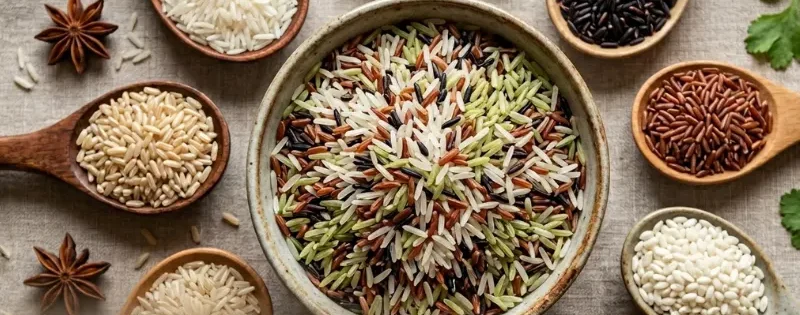
India and rice are inseparable. The country is one of the largest rice producers in the world, grows more varieties of rice than most countries have even heard of, and has been exporting rice across continents for centuries. From the long-grain aromatic basmati that graces tables in the Middle East and Europe, to the short-grain varieties that feed hundreds of millions of Indian households every day, rice from India is as diverse as the country itself.
For international importers, domestic wholesalers, retail brands, and food businesses of all sizes, India represents one of the most attractive sourcing destinations for rice anywhere in the world. The combination of scale, variety, competitive pricing, and an established export infrastructure makes it hard to match.
But sourcing rice from India the right rice, from the right manufacturer, with the right quality is not as simple as placing an order. The market is large, the product range is wide, and the quality differences between suppliers can be significant. This guide is written for buyers who want to understand the landscape clearly before they commit to a sourcing relationship.
Why India Is a Global Rice Powerhouse
To understand why so many buyers around the world turn to India for rice, it helps to start with some context.
India grows rice across an enormous geographic spread from the alluvial plains of Punjab and Haryana in the north, to the river deltas of West Bengal and Odisha in the east, to the fertile fields of Andhra Pradesh and Tamil Nadu in the south. Each region has its own soil composition, water availability, climate, and agricultural tradition and each produces rice with distinct characteristics.
The country produces well over 100 million tonnes of rice annually, making it consistently among the top two or three producers globally. It is also the world’s largest exporter of rice, with exports reaching buyers in more than 150 countries across Asia, the Middle East, Africa, Europe, and the Americas.
This scale matters for buyers. It means there are thousands of rice mills and manufacturers operating across India, producing a range of products that covers virtually every type, quality grade, and processing style a buyer could need. It also means that competition among suppliers keeps pricing competitive and that a well-informed buyer can find excellent value without compromising on quality.
Types of Rice Produced by Indian Manufacturers
Before approaching any rice supplier in India, it’s essential to understand what you’re buying. Indian rice broadly falls into two major categories, each with numerous varieties within them.
Basmati Rice
Basmati is the jewel of Indian rice production. Known globally for its extraordinary length, delicate aroma, and fluffy texture when cooked, basmati rice is grown in a specific geographical region the foothills of the Himalayas, covering parts of Punjab, Haryana, Himachal Pradesh, Uttarakhand, Jammu & Kashmir, and parts of western Uttar Pradesh.
This geographical restriction is backed by a GI (Geographical Indication) tag, which means that rice grown outside this defined region cannot legally be sold as Indian Basmati. The tag protects the product’s integrity and gives international buyers assurance about authenticity.
Within basmati, there are several well-known varieties: Pusa Basmati 1121 one of the most exported varieties globally, prized for its extra-long grain; traditional Basmati, which is considered the finest and most aromatic; Pusa Basmati 1509, popular for its shorter cooking time; and Sharbati Basmati, grown in Madhya Pradesh though technically outside the GI zone.
A genuine basmati rice manufacturer in India will clearly specify the variety, grain length (both raw and cooked), moisture content, broken percentage, and whether the product is aged because aged basmati, stored for one to two years after milling, cooks drier and is preferred by premium buyers.
Non-Basmati Rice
Non-basmati rice accounts for the larger share of both domestic consumption and export volume from India. The varieties within this category are numerous, and each has a distinct market.
Sona Masoori is a lightweight, aromatic medium-grain rice primarily grown in Andhra Pradesh and Karnataka. It’s extremely popular in South Indian households and has a growing export market, particularly among Indian diaspora communities.
IR64 and IR8 are high-yield varieties that are cost-effective and widely used in food processing, rice flour production, and in markets where price sensitivity is the primary consideration.
PR11 and PR14 are Punjab-grown non-basmati varieties popular in the domestic market and some export destinations for their quality and consistent grain size.
Parboiled Rice (Silky/Golden) is rice that has been partially boiled in the husk before milling. Parboiling drives nutrients into the grain, extends shelf life, and changes the texture. It’s a preferred format in West African markets and parts of Southeast Asia.
Raw Milled Rice is the standard white rice husked, milled, and polished without parboiling. It’s the most versatile format and the most widely consumed globally.
Brown Rice retains the bran layer after milling, giving it higher nutritional value. Demand for brown rice has grown significantly in health-conscious markets, and several Indian manufacturers have added brown rice lines to their production.
How Rice Is Manufactured in India The Process
Understanding how rice moves from paddy field to packaged product helps buyers evaluate suppliers and ask the right questions.
Procurement: Rice mills source paddy the raw, unhusked grain either from farmers directly, from procurement agents, or through government mandis (agricultural markets). The quality of the paddy at this stage determines the ceiling for the finished product.
Drying: Freshly harvested paddy carries high moisture. Before milling, it must be dried to the appropriate moisture level typically 14% or below for safe storage and processing.
Husking: The outer husk is removed in the husking stage, producing what is known as brown rice. This stage uses rubber-roll huskers that are calibrated carefully to avoid breaking the grain.
Whitening and Polishing: The bran layer is removed through abrasion to produce white rice. The degree of polishing affects appearance, texture, and nutritional content. Over-polishing produces very white, shiny rice but reduces nutritional value.
Sorting and Grading: This is where quality differentiation happens. Modern rice mills use optical sorters sophisticated machines that scan each grain and eject discoloured, broken, or foreign particles. Sortex-cleaned rice, which has passed through this optical sorting process, commands a premium because of its visual consistency.
Quality Checking: Reputable manufacturers test for moisture content, broken grain percentage, foreign matter, chalk content, and in the case of basmati, grain length before and after cooking.
Packaging: Rice is packed in a range of formats from small retail packs of 1 kg and 5 kg to large 25 kg and 50 kg bags for wholesale and export. Export packaging must meet the importing country’s standards for labelling, material, and hygiene.
Quality Standards and Certifications to Look For
Quality in the rice industry is not just about how the grain looks or tastes. For commercial buyers, it’s about documented, verifiable standards that hold up under regulatory scrutiny in the destination market.
FSSAI Certification
The Food Safety and Standards Authority of India (FSSAI) sets the food safety standards for all food products manufactured and sold in India. Any legitimate rice manufacturer in India must have FSSAI registration or licensing. For buyers sourcing for the domestic market, FSSAI compliance is a non-negotiable baseline.
APEDA Registration
The Agricultural and Processed Food Products Export Development Authority (APEDA) is the regulatory body for agricultural exports in India. Any rice supplier India-based who exports rice must be registered with APEDA. Buyers sourcing for export markets should always verify APEDA registration it confirms that the manufacturer is legally authorized to export and has met the export-grade requirements.
ISO Certification
ISO 9001 (quality management system) and ISO 22000 (food safety management) certifications indicate that a manufacturer has documented, systematic processes in place. These are particularly important for buyers in Europe, North America, and other markets with strict food safety regulations.
HACCP Certification
Hazard Analysis and Critical Control Points (HACCP) is a systematic approach to food safety that identifies and controls potential hazards in the production process. It’s increasingly required by importers in developed markets and is a strong signal of a professionally managed manufacturing operation.
Organic Certifications
For buyers sourcing organic rice, look for certifications from recognized bodies such as India Organic (NPOP), USDA Organic, or EU Organic, depending on the destination market. Organic rice commands a significant price premium and requires rigorous documentation through the supply chain.
How to Find and Evaluate a Rice Manufacturer in India
The practical question for most buyers is: with so many manufacturers operating in India, how do you find the right one?
Start With the Product Specification
Before you search, be very clear about what you need. Variety, grain type (long/medium/short), processing (raw/parboiled/brown), quality grade (broken percentage, moisture content), annual volume requirement, packaging format, and certifications required in your market. The more specific your specification, the faster you can filter suppliers who genuinely match your requirements.
Use Verified Trade Platforms
Platforms like India MART, Trade India, and government-backed portals like APEDA’s trade directory are reasonable starting points for identifying manufacturers. However, always treat these as a first filter not a final verification. Listings are self-submitted and not independently verified.
Verify Credentials Independently
Check FSSAI registration numbers directly on the FSSAI portal. Verify APEDA registration. For ISO or organic certifications, ask for the certificate documents and cross-check with the issuing body. A legitimate manufacturer will provide all of this without hesitation.
Request Samples Before Committing
No matter how impressive a supplier’s presentation looks, always request and test samples before placing a commercial order. Test for grain length, aroma (for basmati), broken percentage, moisture content, and cooking quality. For basmati, cook a small quantity and measure the cooked grain length a genuine 1121 basmati should elongate to at least 20–22mm when cooked.
Visit the Facility if Possible
For significant sourcing relationships, a factory visit is worth the investment. It lets you see the equipment, assess hygiene standards, understand the team’s capability, and build a direct relationship with the people you’ll be working with. Many rice manufacturers in India particularly those with established export operations regularly host buyer visits and are accustomed to the process.
Start With a Trial Order
Before committing to a large annual contract, place a smaller trial order. Evaluate not just the product quality but the entire commercial experience how the manufacturer communicates, whether documentation is accurate and timely, whether the shipment arrives on schedule, and whether the product matches the samples. These signals tell you a great deal about what a long-term relationship will look like.
Common Mistakes Buyers Make When Sourcing Rice from India
Even experienced procurement professionals make avoidable errors. Here are the most common ones.
Focusing only on price: The rice market has a range of quality grades, and price differences are real. A quotation that seems significantly cheaper than others usually means a lower grade higher broken percentage, more moisture, less careful sorting. Always compare like for like.
Not specifying moisture content: Rice with moisture above 14% is at risk of mould during transit, particularly in humid conditions. Always specify maximum acceptable moisture content in your purchase agreement.
Skipping sample testing: Samples exist for a reason. Never commit to volume without physically testing the product especially for basmati, where grain length, aroma, and cooking behaviour vary significantly between varieties and between suppliers.
Ignoring broken rice percentage: The broken grain percentage directly affects the cooking quality and the value of the product. For premium basmati, buyers typically specify 1–2% broken maximum. For lower-grade non-basmati, this may be higher. Always agree on this in writing.
Not verifying export documentation requirements: Different importing countries have different requirements phytosanitary certificates, pesticide residue testing, fumigation certificates, and country-specific labelling rules all need to be addressed before the shipment leaves India.
India’s rice industry is one of the most mature, diverse, and export-ready agricultural sectors in the world. Whether you’re looking for premium aged basmati for a high-end retail brand, parboiled rice for West African markets, or organic brown rice for a health food range, there is a rice manufacturer in India capable of supplying it to the standard you need.
The key to getting it right is preparation. Know your product specification clearly. Verify credentials rigorously. Test before you commit. And build relationships with suppliers who communicate transparently and consistently deliver on what they promise.