There are very few foods on earth that can claim to be simultaneously ancient and trending. Green mung beans are one of them.
Cultivated for thousands of years across South Asia and Southeast Asia, mung beans have been a staple of Indian, Chinese, Thai, Vietnamese, and Korean cuisines for longer than most written records exist. They fed civilisations, sustained farming communities, and formed the backbone of plant-based diets long before plant-based was a marketing category.
Today, green mung beans are having what can only be described as a global moment. The plant-based food industry has discovered their protein content. Health-conscious consumers are rediscovering their digestive and nutritional benefits. Food manufacturers are incorporating mung bean protein isolate into everything from meat alternatives to protein bars. And international buyers from European importers to American food brands to Middle Eastern wholesalers are looking to India, one of the world’s largest mung bean producers, as their primary sourcing origin.
Whether you are a buyer sourcing in bulk, a food brand exploring ingredients, a health-conscious consumer wanting to understand what you’re eating, or a business evaluating the global mung bean trade, this guide covers everything you need to know clearly, thoroughly, and practically.
What Are Green Mung Beans?
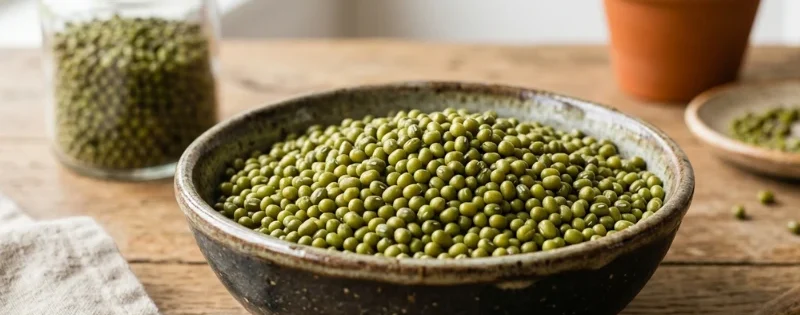
Green mung beans known botanically as Vigna radiata are small, oval-shaped legumes with a characteristic bright green outer skin and a pale yellow interior. They belong to the legume family alongside lentils, chickpeas, and black-eyed peas, and share many of the nutritional properties that make legumes such an important category in global food systems.
The “green” in green mung beans refers to the colour of the outer hull when the bean is whole. When the hull is removed and the bean is split, you get what Indian cuisine calls moong dal yellow in colour, faster to cook, and slightly different in texture and flavour.
Mung beans grow best in warm, semi-arid conditions and are well-suited to the agricultural landscapes of India, China, Myanmar, Thailand, Vietnam, Indonesia, and parts of Africa. They are a short-duration crop typically ready for harvest in 60 to 75 days which makes them attractive to farmers as a rotation crop between longer-duration cereals.
India is one of the world’s largest producers and a significant global exporter. The crop is grown across multiple states, with Rajasthan, Madhya Pradesh, Maharashtra, Andhra Pradesh, and Karnataka being the primary producing regions.
Types and Formats of Green Mung Beans
Understanding the different forms in which green mung beans are available is essential for buyers and food professionals.
Whole Green Mung Beans
The most traded form internationally. The bean is harvested, cleaned, sorted, and sold with the green hull intact. Whole mung beans have a longer cooking time than their split counterparts, but they hold their shape well and are ideal for sprouting, soups, curries, stews, and grain bowl applications.
For buyers, whole green mung beans are graded by size bold, medium, and small and by visual quality factors like colour uniformity, broken percentage, and foreign matter content. Premium grades are characterised by a vivid, uniform green colour, minimal broken beans, and low moisture content.
Split Mung Beans (With Skin)
When whole mung beans are split along their natural seam without removing the hull, you get split mung beans with skin. These cook faster than whole beans and are used in a range of South Asian recipes. They are less commonly traded internationally than either whole beans or hulled split dal.
Hulled and Split Mung Beans (Yellow Moong Dal)
When the green hull is removed and the bean is split, the result is the familiar yellow moong dal of Indian cooking. This is a completely different visual and culinary product from whole green mung beans, though it comes from the same source. Yellow moong dal cooks quickly, has a mild flavour, and is widely used in dal preparations, khichdi, soups, and baby food formulations.
Mung Bean Sprouts
When whole green mung beans are soaked and allowed to germinate, they produce sprouts the crisp, white, mildly flavoured sprouts found in Asian cooking and salads globally. Sprouting changes the nutritional profile of the bean, reduces antinutrients, and makes certain nutrients more bioavailable. The sprout market is distinct from the dry bean market and is largely supplied by local sprouting operations close to consumption centres rather than through long-distance trade.
Mung Bean Flour
Ground from whole or dehulled mung beans, mung bean flour is used in noodle manufacturing (glass noodles are traditionally made from mung bean starch), bakery applications, baby food, and increasingly in gluten-free product formulations. Demand for mung bean flour has grown alongside the broader gluten-free food movement.
Mung Bean Protein Isolate
This is the ingredient driving the most excitement in the global food industry right now. Mung bean protein isolate is produced by extracting and concentrating the protein content of mung beans typically to 70–90% protein by weight. It is used in plant-based meat products, protein beverages, sports nutrition, and functional foods. Several major plant-based food companies have shifted to mung bean protein as a primary ingredient, attracted by its clean flavour profile and amino acid composition relative to alternatives like pea protein.
Nutritional Profile of Green Mung Beans
Green mung beans are genuinely nutritious not in the vague, marketing-speak sense, but in the measurable, documented sense that makes them worth including in a balanced diet.
Per 100 grams of cooked whole green mung beans, you can expect approximately:
Protein: 7–8 grams a meaningful plant protein source, particularly valuable for vegetarian and vegan diets
Dietary Fibre: 7–8 grams supports digestive health, feeds beneficial gut bacteria, and contributes to satiety
Carbohydrates: 19–20 grams predominantly complex carbohydrates with a relatively low glycaemic index
Fat: less than 1 gram making mung beans one of the lowest-fat legumes available
Folate: approximately 40% of the recommended daily intake critical for cell division and particularly important during pregnancy
Manganese: over 30% of daily recommended intake supports bone health and metabolic function
Magnesium, Potassium, Iron, Zinc, Copper: all present in meaningful quantities
What makes the mung bean’s nutritional profile particularly notable is not just the individual nutrients but the combination. The protein-to-calorie ratio is high. The fibre content is substantial. The micronutrient density is impressive. And unlike many high-protein plant foods, mung beans are easy to digest a property that Ayurvedic medicine has recognised for centuries and that modern nutritional science is now validating.
Antinutrients and Digestibility
Like all legumes, raw mung beans contain antinutrients compounds like phytic acid and trypsin inhibitors that can reduce the bioavailability of certain nutrients and cause digestive discomfort in some people. However, mung beans have notably lower levels of these compounds than many other legumes. Soaking, cooking, and sprouting all further reduce antinutrient content and improve digestibility, making mung beans one of the most gut-friendly legumes for regular consumption.
The Glycaemic Index Advantage
For buyers supplying health-conscious markets or food brands targeting diabetic or metabolic health consumers, the mung bean’s glycaemic index is a significant selling point. Whole cooked mung beans have a GI of approximately 25–35 low by any standard. This makes them suitable for blood sugar management diets and a credible ingredient for functional food formulations targeting this growing consumer segment.
Green Mung Beans in Global Cuisine and Food Industry
The culinary range of green mung beans is one of the most remarkable things about the ingredient and one of the least appreciated outside the regions where it has always been cooked.
In India, mung beans appear in everything from simple everyday dals and khichdi to elaborate street food preparations. Moong dal chilla thin, protein-rich savoury pancakes are consumed daily by millions. Whole green mung beans are cooked into curries, sprouted into chaats, and ground into batters for various regional dishes.
In China, mung beans are used to make a sweet, cooling soup consumed during summer months for their perceived heat-reducing properties in traditional Chinese medicine. Mung bean starch is the basis for the glass noodles used across Chinese, Thai, Korean, and Vietnamese cooking.
In Southeast Asia, mung beans appear in both savoury and sweet applications from Vietnamese chè (sweet dessert soups) to Thai spring roll fillings and Indonesian bakso ingredients.
In the global health food market, mung beans are positioned as a superfood high in protein, rich in fibre, low in fat, easy to digest, and clean in flavour. This positioning has opened significant new markets in Europe, North America, and Australia that barely consumed mung beans a decade ago.
For food manufacturers, mung bean protein’s relatively neutral flavour compared to pea protein or soy protein is a compelling advantage. Products made with mung bean protein isolate don’t carry the beany off-notes that have challenged formulators working with other legume proteins. This is one reason companies like JUST Egg chose mung bean protein as their primary ingredient for a plant-based egg product that actually behaves and tastes like egg.
India’s Role in Global Green Mung Bean Trade
India’s importance as a mung bean producing and exporting nation cannot be overstated. The country grows mung beans across a large geographic spread, benefits from two distinct cropping seasons, and has a well-developed pulse milling and export infrastructure.
The primary mung bean growing states in India are Rajasthan and Madhya Pradesh in the north and central regions, which together account for the majority of national production. Maharashtra, Andhra Pradesh, Karnataka, and Gujarat also contribute significantly to the national crop.
India exports green mung beans to a diverse range of markets. South and Southeast Asia particularly Bangladesh, Sri Lanka, Indonesia, Malaysia, and the Philippines are among the largest volume buyers. The Middle East is a significant market, particularly for the Indian diaspora consumer segment. European buyers, while representing lower volumes, often demand higher quality grades and more stringent certification standards. China has in various seasons been a major buyer of Indian mung beans, particularly when domestic supply is short.
Pricing for green mung beans from India is influenced by crop size, rainfall patterns during the growing season, competing demand from domestic consumption, and global supply from alternative origins like Myanmar, which is a significant competing producer. Understanding these dynamics helps buyers plan procurement timing and negotiate more effectively.
Quality Standards and Certifications for Mung Bean Sourcing
For buyers importing green mung beans from India, quality documentation is not a formality it is the mechanism by which you verify that what you’re paying for is what you’ll receive.
FSSAI Licensing
All food businesses in India, including mung bean processors and exporters, must hold FSSAI (Food Safety and Standards Authority of India) registration or licensing. This is the foundational food safety credential for the Indian market. Always verify FSSAI license numbers directly on the FSSAI portal.
APEDA Registration
The Agricultural and Processed Food Products Export Development Authority oversees India’s agricultural exports. Any legitimate pulse exporter including mung bean suppliers must be registered with APEDA. Registration can be verified through APEDA’s official online registry. This is a non-negotiable check for any international buyer.
ISO 22000 and HACCP
For buyers supplying regulated markets in Europe, North America, or Japan, ISO 22000 food safety management certification and HACCP implementation are increasingly standard requirements. These certifications indicate that the supplier has documented, audited food safety systems not merely a verbal commitment to quality.
Pesticide Residue Testing
Mung beans imported into the European Union are subject to maximum residue limits (MRLs) for pesticides under EU Regulation 396/2005. Indian mung bean shipments have historically attracted scrutiny at EU border inspection posts for pesticide residue non-compliance. Buyers supplying EU markets should require pesticide residue testing reports from accredited laboratories for every shipment not just spot checks.
Organic Certifications
The demand for certified organic mung beans has grown substantially. For export to the EU, suppliers need certification under EC 834/2007. For the US market, USDA NOP certification applies. Indian organic mung bean production is growing, with certified suppliers concentrated in Rajasthan and Madhya Pradesh where the agricultural conditions suit organic cultivation.
How to Source Green Mung Beans from India A Practical Guide
Step 1 Define Your Specification Clearly
Before approaching any supplier, document exactly what you need: whole green mung beans or a specific processed format, grade (bold/medium/small), maximum broken percentage, moisture content limit, foreign matter tolerance, annual volume requirement, packaging format (25 kg bags, 50 kg bags, bulk), and certifications required.
Step 2 Identify and Shortlist Suppliers
Use trade directories like India MART, Trade India, and the APEDA pulse exporter database to generate an initial list. Treat these as starting points only not as quality endorsements. Cross-reference with company websites, export records (available through Indian customs data providers), and any industry references you can access.
Step 3 Verify Credentials Independently
Check FSSAI license status on the FSSAI portal. Verify APEDA registration. Request copies of ISO and organic certifications and confirm their validity with the issuing bodies. Ask for recent export documentation bills of lading, phytosanitary certificates as evidence of genuine export experience.
Step 4 Request and Test Samples
Obtain samples from shortlisted suppliers and have them tested by an independent accredited laboratory. Key parameters to test include moisture content, broken bean percentage, foreign matter, and pesticide residues if supplying EU or other regulated markets. Visually assess colour uniformity and overall cleanliness a premium grade green mung bean should have a vivid, consistent green colour with minimal discolouration.
Step 5 Conduct a Supplier Audit
For significant sourcing relationships, a facility audit either in person or through a third-party inspection agency is a worthwhile investment. Assess storage conditions (dry, well-ventilated warehousing is essential for mung beans), cleaning and sorting equipment, pest control measures, and the supplier’s quality management documentation.
Step 6 Start with a Trial Order
Before committing to a long-term supply agreement, place a trial order. Evaluate not just the product quality but the entire commercial experience communication responsiveness, documentation accuracy, packaging quality, and on-time delivery. These early signals are highly predictive of long-term supply reliability.
Common Sourcing Mistakes to Avoid
Not specifying moisture content: Mung beans with moisture above 12% are at risk of mould and quality degradation during transit and storage. Always specify maximum acceptable moisture in your purchase contract.
Overlooking pesticide residue risk for EU markets: This is the single most common reason Indian pulse shipments are rejected at EU ports. Independent pre-shipment testing is essential not optional.
Choosing price over supply chain transparency: A significantly lower quote often signals corners being cut somewhere in the supply chain inferior sorting, inadequate storage, or mixed-grade product. Always compare on verified specification, not just headline price.
Ignoring seasonal price dynamics: Mung bean prices in India shift significantly around harvest periods. Buyers who plan procurement in advance and understand the crop calendar negotiate significantly better terms than those who buy reactively.
Working through too many intermediaries: Each layer between you and the actual processing facility adds cost, reduces traceability, and dilutes accountability. Where possible, work directly with registered exporters who control their own processing and storage.
Green mung beans are one of those rare ingredients that genuinely deserve the attention they are receiving right now. The nutritional credentials are real. The culinary versatility is exceptional. The global demand trajectory is clearly upward. And India’s capacity to supply them in volume, in quality, and in a range of processed formats is well-established.
For buyers, the opportunity is significant. But so is the responsibility to source carefully. A shipment of mung beans that fails pesticide residue testing at a European port, or arrives with excessive moisture and mould, is not just a financial loss it is a supply chain failure that affects your customers and your reputation.